I was a NASCAR fan when I was young, but I have not followed auto racing regularly since I was a teenager. I only recently noticed that back in July, Dale Earnhardt Jr. won the Subway Jalapeño 250 at Daytona International Speedway. This was Dale Jr.'s first win in a points-earning NASCAR race since 2008. The Chevrolet that Junior happened to be driving carried a Wrangle sponsorship and the number 3. That particular combination was made famous by his father.
The race won by Junior was part of the Nationwide Series. Relative to the top-level Sprint Cup Series, the Nationwide Series and the Camping World Truck Series are analogous to minor leagues in baseball. There is one important difference however between baseball and NASCAR in this regard. Baseball players from the major leagues occasionally make appearances in the minor leagues, primarily on rehab stints while recovering from an injury. A veteran player who no longer has a contract with a major-league team may also play in the minors in an effort to work his back to the majors. On the other hand, NASCAR drivers frequently participate in races at various different levels. It is not rare to see Sprint Cup drivers racing and winning Nationwide and truck races.
When I read about Junior's win, it occurred to me that Dale Jr. has sort of become NASCAR's version of the NFL's Oakland Raiders. Fans of both remember an earlier generation when the the objects of their adoration were known for being mean, nasty and overly aggressive. Both were also known for sporting black, but more importantly they were consistent winners. They would do whatever it took to achieve victory.
When Dale Earnhardt, Sr. was racing, the major-league NASCAR series was known as the Winston Cup Series. Senior won seven series championships which is tied for most with Richard Petty. Both he and Petty were inaugural inductees of the NASCAR Hall of Fame. Dale, Sr. won 76 races out of the 677 Winston Cup races that he started in during his career. That means he won 11.2% of the time. On the other hand, Junior has won 18 out of 384 Sprint Cup races. Considering that NASCAR races generally have 43 drivers in the field, winning 4.7% of the time is not shabby. However, it pales in comparison to his father's achievements.
The history of the Raiders includes three Super Bowl victories and thirteen Hall of Fame players. Their last Super Bowl victory was Super Bowl XVIII in 1984. More recently, they lost Super Bowl XXXVII in 2003 to the Tampa Bay Buccaneers. In the seven seasons since that Super Bowl loss, the team has only won 29 games while losing 83 for a woeful winning percentage of 25.9. Both Oakland and Junior continue to carry the names Raiders and Dale Earnhardt, but both current versions are mere shadows of the previous incarnations.
While discussing the subject of this post with El, she suggested including Johnny Cash in the mix. He was also known for wearing black and could be a bit mean. He is also dead which does not allow him to match up with his previous greatness. His first daughter Rosanne Cash has been somewhat successful in the music business. His only son, John Carter Cash, has been less successful. I suppose the analogy could fit Johnny Cash, however, I think it would be a bit of a stretch.
Sunday, October 10, 2010


Sunday, October 3, 2010
Carolina Hockey
This will be my second straight post discussing the Carolinas, but this post will be about sports, specifically ice hockey, and not beer. This year, two minor league hockey franchises have relocated to the Carolinas. Back in February, I posted about Charlotte getting a new AHL franchise. There is also a new ECHL franchise in Greenville, South Carolina.
Charlotte's new franchise kept the name of the city's previous ECHL team, the Checkers. The new team is the AHL affiliate of the Carolina Hurricanes. Back in June, the Checkers unvieled new logos and jersey designs. The team's new primary logo is a duplicate of the previous logo, but with the colors changed from powered blue and navy blue to black and silver to match the colors of the parent club. To further tie the new team to the Hurricanes, the new alternate logo features the team's polar bear mascot carrying a hockey stick with a tropical storm flag. The new sweaters are just replicas of the three that the Hurricanes wear only with the Checkers logos on the chest.
Taken altogether, I do not particularly care for these changes. While I understand that the overall goal is to promote the parent club throughout the Carolinas, I do not think that making the Checkers clones of the Hurricanes is the best way of achieving that goal. The main problem is that the themes of two teams do not match. Why does a team with a polar bear as its mascot have jerseys with tropical warning flags trimming the bottom? In my opinion, the Checkers should have maintained the colors and jerseys of the previous franchise. The team should only have a single Hurricanes-clone jersey which would only be worn for certain games. That jersey would be red but with the team's alternate logo which I like. The games when those sweaters are worn could be specifically geared towards promoting the Canes. Perhaps, some of the Hurricanes players and Stormy, the Hurricanes' mascot, could make the trip down for those games.
The previous incarnation of the Checkers was affiliated with the New York Rangers. Replacing the Checkers as the ECHL affiliate of the Rangers is the Greenville Road Warriors. The Road Warriors were previously the Johnstown Chiefs before moving to South Carolina. The team will play in the BI-LO Center which is located in downtown Greenville. The name for the team was chosen via a fan-submission contest and is a homage to the area's link to the automotive industry. I like the team's colors and logo. However, I would drop "Road" from the team name and just go with the "Warriors" for the name.
Speaking of road warriors, that term could definitely be applied to the major league team in Raleigh. The Hurricanes are experiencing big changes this year. At the top, longtime captain Rod Brind'Amour has retired, and Eric Staal begins his first full year serving as captain. There are also several new young players. The Canes have gone from the second-oldest team last year with the average age of their players being 29.3 years to the 26th oldest this year with an average age of 27.2. Those players will be a bit older before the team's first true home game this season. The team's first home game will be the second of two games against the Minnesota Wild to be played in Helsinki, Finland. After returning to this country, the next five games for the team are on the road. This is primarily thanks to the North Carolina State Fair which runs from October 14-24. The RBC Center, the team's home, shares parking space with the fairgrounds and also Carter–Finley Stadium, home to the N. C. State's football team. The Wolfpack have an away game and a bye week while the fair is in town. The first game at the RBC Center for the Hurricanes is October 27 versus the Capitals.
Charlotte's new franchise kept the name of the city's previous ECHL team, the Checkers. The new team is the AHL affiliate of the Carolina Hurricanes. Back in June, the Checkers unvieled new logos and jersey designs. The team's new primary logo is a duplicate of the previous logo, but with the colors changed from powered blue and navy blue to black and silver to match the colors of the parent club. To further tie the new team to the Hurricanes, the new alternate logo features the team's polar bear mascot carrying a hockey stick with a tropical storm flag. The new sweaters are just replicas of the three that the Hurricanes wear only with the Checkers logos on the chest.


Taken altogether, I do not particularly care for these changes. While I understand that the overall goal is to promote the parent club throughout the Carolinas, I do not think that making the Checkers clones of the Hurricanes is the best way of achieving that goal. The main problem is that the themes of two teams do not match. Why does a team with a polar bear as its mascot have jerseys with tropical warning flags trimming the bottom? In my opinion, the Checkers should have maintained the colors and jerseys of the previous franchise. The team should only have a single Hurricanes-clone jersey which would only be worn for certain games. That jersey would be red but with the team's alternate logo which I like. The games when those sweaters are worn could be specifically geared towards promoting the Canes. Perhaps, some of the Hurricanes players and Stormy, the Hurricanes' mascot, could make the trip down for those games.


The previous incarnation of the Checkers was affiliated with the New York Rangers. Replacing the Checkers as the ECHL affiliate of the Rangers is the Greenville Road Warriors. The Road Warriors were previously the Johnstown Chiefs before moving to South Carolina. The team will play in the BI-LO Center which is located in downtown Greenville. The name for the team was chosen via a fan-submission contest and is a homage to the area's link to the automotive industry. I like the team's colors and logo. However, I would drop "Road" from the team name and just go with the "Warriors" for the name.

Speaking of road warriors, that term could definitely be applied to the major league team in Raleigh. The Hurricanes are experiencing big changes this year. At the top, longtime captain Rod Brind'Amour has retired, and Eric Staal begins his first full year serving as captain. There are also several new young players. The Canes have gone from the second-oldest team last year with the average age of their players being 29.3 years to the 26th oldest this year with an average age of 27.2. Those players will be a bit older before the team's first true home game this season. The team's first home game will be the second of two games against the Minnesota Wild to be played in Helsinki, Finland. After returning to this country, the next five games for the team are on the road. This is primarily thanks to the North Carolina State Fair which runs from October 14-24. The RBC Center, the team's home, shares parking space with the fairgrounds and also Carter–Finley Stadium, home to the N. C. State's football team. The Wolfpack have an away game and a bye week while the fair is in town. The first game at the RBC Center for the Hurricanes is October 27 versus the Capitals.
Sunday, September 26, 2010
Confusion in Carolina
No, this post is not about the woeful Carolina Panthers who are now 0-3 after a sloppy loss to the Bengals today. The Cats do looked confused on the field though. Things are not looking any better with upcoming games against the Saints and Bears.
Living in North Carolina and enjoying many different types of beers, I like trying the various local brews. There is one problem with beer from this area however, particularly if you are trying to keep track of what you are drinking. There are multiple brews available with "Carolina" in the name. In fact, there are two separate operations with "Carolina Brew..." in their name. The Carolina Brewing Company is located in the town of Holly Springs which is a short drive south of Raleigh. Their Spring Bock and Summer Wheat are on my Beer List, and I have previously had some of their other brews.
There is also Carolina Brewery which operates two brewpubs in this area. The original is in Chapel Hill. I have never been to that location, but I have been to their newer location in Pittsboro. Beers from Carolina Brewery are available in other places besides the two brewpubs.
In addition to the "Brewing Company" and "Brewery", there is the "Beer Company". Carolina Beer Company is located in Mooresville which is just north of Charlotte. They offer "Carolina"-branded beers plus specialty brews under the Cottonwood brand. Their Cottonwood Pumpkin Ale was the first pumpkin-flavored beer that I tried, and I still think it is the best pumpkin beer I have tasted. Try it in a half-and-half with Guinness or Murphy's Stout.
Finally, there is the string of Carolina Ale House locations. To be completely confusing, they offer their own special brews plus they have beers from the Carolina Brewing Company on tap. The Ale House's Hat Trick Red is on my Beer List.
Ordering a draft of the "Carolina" special around here is an iffy proposition. I was recently at a bar, and I had an oatmeal porter and an Oktoberfest from one of the "Carolina"-named companies. It took some investigation, but I was able to figure out that these two beers were from Carolina Brewery. First, I had the Oatmeal Porter. The Internet tells me that the addition of oatmeal to a porter or stout gives a smooth creaminess. That is definitely the case for this brew. It is a delicious beer, but one is really all I could drink. I followed the Oatmeal Porter with the Oktoberfest. Not quite as tasty as the smooth porter, but also a good beer.
While I am on the subject of local beers, I would like to mention a new brewery that recently opened in north Raleigh. According to their website, Roth Brewing Company was founded in 2008, but their beers have only started appearing in the past few months. I have only had two of their beers, and to be completely honest, I did not care for either one. Their FoeHammer is a big barleywine with a hefty 10.5% ABV. I thought this beer had a very strong alcohol flavor. It seems to be a high-gravity beer for the sake of the high-alcohol content. I have also tried their Forgotten Hollow which is suppose to be a cinnamon porter. It definitely was flavorful, but to me it did not taste like cinnamon. Even though I did not care for these two brews, I would still like to welcome Roth to the neighborhood. I am looking forward to trying more of their offerings, and I am sure I will find several that I enjoy.
Living in North Carolina and enjoying many different types of beers, I like trying the various local brews. There is one problem with beer from this area however, particularly if you are trying to keep track of what you are drinking. There are multiple brews available with "Carolina" in the name. In fact, there are two separate operations with "Carolina Brew..." in their name. The Carolina Brewing Company is located in the town of Holly Springs which is a short drive south of Raleigh. Their Spring Bock and Summer Wheat are on my Beer List, and I have previously had some of their other brews.
There is also Carolina Brewery which operates two brewpubs in this area. The original is in Chapel Hill. I have never been to that location, but I have been to their newer location in Pittsboro. Beers from Carolina Brewery are available in other places besides the two brewpubs.
In addition to the "Brewing Company" and "Brewery", there is the "Beer Company". Carolina Beer Company is located in Mooresville which is just north of Charlotte. They offer "Carolina"-branded beers plus specialty brews under the Cottonwood brand. Their Cottonwood Pumpkin Ale was the first pumpkin-flavored beer that I tried, and I still think it is the best pumpkin beer I have tasted. Try it in a half-and-half with Guinness or Murphy's Stout.
Finally, there is the string of Carolina Ale House locations. To be completely confusing, they offer their own special brews plus they have beers from the Carolina Brewing Company on tap. The Ale House's Hat Trick Red is on my Beer List.
Ordering a draft of the "Carolina" special around here is an iffy proposition. I was recently at a bar, and I had an oatmeal porter and an Oktoberfest from one of the "Carolina"-named companies. It took some investigation, but I was able to figure out that these two beers were from Carolina Brewery. First, I had the Oatmeal Porter. The Internet tells me that the addition of oatmeal to a porter or stout gives a smooth creaminess. That is definitely the case for this brew. It is a delicious beer, but one is really all I could drink. I followed the Oatmeal Porter with the Oktoberfest. Not quite as tasty as the smooth porter, but also a good beer.
While I am on the subject of local beers, I would like to mention a new brewery that recently opened in north Raleigh. According to their website, Roth Brewing Company was founded in 2008, but their beers have only started appearing in the past few months. I have only had two of their beers, and to be completely honest, I did not care for either one. Their FoeHammer is a big barleywine with a hefty 10.5% ABV. I thought this beer had a very strong alcohol flavor. It seems to be a high-gravity beer for the sake of the high-alcohol content. I have also tried their Forgotten Hollow which is suppose to be a cinnamon porter. It definitely was flavorful, but to me it did not taste like cinnamon. Even though I did not care for these two brews, I would still like to welcome Roth to the neighborhood. I am looking forward to trying more of their offerings, and I am sure I will find several that I enjoy.
Saturday, September 25, 2010
That's a Great Idea
Today's post was originally going to be about beers from a couple of local breweries. I will get around to that post eventually. However, I was reading the most recent article from ESPN.com's Bill Simmons who has a familiar idea. In his article, he complains about the recent futility of the NFL's NFC West division. He blames the problem on the small divisions in the NFL and proposes to correct the issue via realignment. While he attempts to maintain the two conferences, his proposed alignment is very similar to one of my proposals. My first proposal eliminated the AFC and NFC and simply combined the directional divisions. My followup realignment proposal had the Baltimore Ravens, Indianapolis Colts and Miami Dolphins rotating divisions. The only difference between that proposal and his suggestion is that he has the Dallas Cowboys in the geographically-correct "NFC South" (my "South Division") which moves the Carolina Panthers to the "AFC East" (my "East Division"). Despite any excitement over this weekend's Lone Star showdown with the Houston Texans, I seriously doubt Cowboy's owner Jerry Jones would ever agree to give up the Cowboy's traditional rivalries with the other NFC East teams.
While our divisional alignments are similar, our schedule proposals are vastly different. He proposes a complicated 18-game schedule which includes only playing home and away games against some divisional opponents while only playing one game versus others. He also fits in eight games against teams from the other divisions. My proposal comes in 16- and 17-game flavors. Teams would play home and away games against each of the other seven teams in their divisions for a total of 14 games plus games against one team from either two or three of the other divisions. I just do not feel that the NFL will go to an 18-game schedule. I think the idea of expanding the regular season to 18 games is a negotiating ploy by the NFL team owners with the players union. If the idea does not get dropped completed in favor of some concessions by the players, I think the two sides will compromise by expanding to only 17 games.
While our divisional alignments are similar, our schedule proposals are vastly different. He proposes a complicated 18-game schedule which includes only playing home and away games against some divisional opponents while only playing one game versus others. He also fits in eight games against teams from the other divisions. My proposal comes in 16- and 17-game flavors. Teams would play home and away games against each of the other seven teams in their divisions for a total of 14 games plus games against one team from either two or three of the other divisions. I just do not feel that the NFL will go to an 18-game schedule. I think the idea of expanding the regular season to 18 games is a negotiating ploy by the NFL team owners with the players union. If the idea does not get dropped completed in favor of some concessions by the players, I think the two sides will compromise by expanding to only 17 games.
Sunday, September 19, 2010
Super Secret Formula
As I have previously discussed, I, like many people, play fantasy football. For the past few years, I have been in two leagues. As I think is common in fantasy leagues, both of my leagues release a weekly power ranking. Ever since I joined a 10-team league with some guys at work, the power rankings have been sent out each week as a large Excel spreadsheet. The spreadsheet tracks various pieces of data. First is the points scored by every team with the high and low scores from each week highlighted. Next, there is the number of other teams each team would have beaten for every week. Finally, there are the wins and losses for the season. The data in each category is cumulative as the season goes along. The ten teams are ranked in each of the three categories. The best team in each category gets 10 points and the worst gets 1 point. The teams are ranked based on the sum of the three rankings. Therefore, the best possible score would be 30 points and the worst would be three.
My other league has twelve teams. One of the other owners is Alan, a college buddy mine. His brother Matt is the league manager. The other owners are various friends of theirs. When the league first got started, Matt would post weekly power rankings based on his own personal opinions. While that was interesting and generated fun posts on the league's message board, I felt that I could come up with rankings that more accurately reflected the strength of the teams. I knew I would be using a spreadsheet, but I did not want to maintain data from previous weeks as is done on my other league. Therefore, I wanted to only use data available for the current week.
Both of my leagues are on ESPN.com. The standings page on ESPN.com includes two tables. The top table has wins (W), losses (L), ties (T), winning percentage (PCT), and games behind the first place team in the standings (GB). The second table has points scored for (PF), points scored against (PA), home record, away record, division record, and streak of either winning, losing or tying. (I have seen a tying streak of two). In my fantasy leagues, the home and away records are meaningless. My 12-team league only has one large division, so in that league, the division record is also meaningless.
I have been constantly evolving my ranking formula since I first began. I started by simply copying and pasting the standings data into a spreadsheet and then playing around with it. I eventually settled on using four of the available data categories. To the right is example standings from last season showing the four components. I think PCT, PF and streak are pretty obvious. Teams with the best PCT and PF have good arguments for being the best team. The streak component answers the "What have you done lately?" question. Regardless of the other data, would you rather play a team on a long winning streak or a long losing streak?
Probably the only questionable component is PA which I include in the formula as an adder instead of a negative. In fantasy football, the players on your team have no affect on your opponent's performance. Therefore, it is my opinion that PA represents the strength of a team's schedule. I think including PA as one of the components helps teams that have scored a good number of points, but do not have great winning percentages or long winning streaks because they have played teams that have also scored a lot of points.
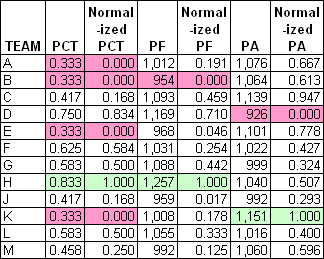
If you thought things were geeky already, it is now going to get even geekier. For each component, I normalize the values. Normalization is a mathematical technique were a set of values are mapped between one and zero with the highest value being set to one and the lowest value being set to zero. All the other values are somewhere in between. To normalize a set of numbers, each number is subtracted by the minimum value in the group and the result is divided by maximum value minus the minimum value. Here are the example standings again with columns added for the normalized values of PCT, PF and PA. I have highlighted the highest and lowest values for each component.
Normalizing the streak value is a bit more complicated since there can be winning streaks, losing streaks, and even tying streaks. Before doing the normalization, the formula converts winning streaks to positive numbers, losing streaks to negative numbers, and tying streaks of any length to zero. Here are the streaks for the example teams with the plus-or-minus values and the normalized values. Unfortunately, my snapshot from last year does not include any teams with a streak of ties, but if there were teams on a tie streak those values would be set to zero which would fall somewhere near the middle of the range after being normalized.
Of course, the four components are not all equal. I think winning percentage and points scored are more important factors and should have more influence in the formula. Streak should have less influence, and PA should have the least. The weight assigned to each of the components can be easily changed in the spreadsheet. I have the weights listed as percentages. The weights for the four components should add up to 100%. My spreadsheet does not strictly enforce that particular rule, but does make it obvious when the weights do not sum up properly. I chose to give PCT a weight of 30%, PF a weight of 40%, PA a weight of 10%, and streak a weight of 20%.
The component values for each team are multiplied by their selected weights and are then added together to give a score that should fall into the range between zero and one if the weights were chosen properly. The teams are then sorted by their scores to give the weekly rankings. Here are the scores from the example sorted from highest to lowest.
My other league has twelve teams. One of the other owners is Alan, a college buddy mine. His brother Matt is the league manager. The other owners are various friends of theirs. When the league first got started, Matt would post weekly power rankings based on his own personal opinions.
 While that was interesting and generated fun posts on the league's message board, I felt that I could come up with rankings that more accurately reflected the strength of the teams. I knew I would be using a spreadsheet, but I did not want to maintain data from previous weeks as is done on my other league. Therefore, I wanted to only use data available for the current week.
Both of my leagues are on ESPN.com. The standings page on ESPN.com includes two tables. The top table has wins (W), losses (L), ties (T), winning percentage (PCT), and games behind the first place team in the standings (GB). The second table has points scored for (PF), points scored against (PA), home record, away record, division record, and streak of either winning, losing or tying. (I have seen a tying streak of two). In my fantasy leagues, the home and away records are meaningless. My 12-team league only has one large division, so in that league, the division record is also meaningless.
I have been constantly evolving my ranking formula since I first began. I started by simply copying and pasting the standings data into a spreadsheet and then playing around with it.
 I eventually settled on using four of the available data categories. To the right is example standings from last season showing the four components. I think PCT, PF and streak are pretty obvious. Teams with the best PCT and PF have good arguments for being the best team. The streak component answers the "What have you done lately?" question. Regardless of the other data, would you rather play a team on a long winning streak or a long losing streak?
Probably the only questionable component is PA which I include in the formula as an adder instead of a negative. In fantasy football, the players on your team have no affect on your opponent's performance. Therefore, it is my opinion that PA represents the strength of a team's schedule. I think including PA as one of the components helps teams that have scored a good number of points, but do not have great winning percentages or long winning streaks because they have played teams that have also scored a lot of points.
If you thought things were geeky already, it is now going to get even geekier.
 For each component, I normalize the values. Normalization is a mathematical technique were a set of values are mapped between one and zero with the highest value being set to one and the lowest value being set to zero. All the other values are somewhere in between. To normalize a set of numbers, each number is subtracted by the minimum value in the group and the result is divided by maximum value minus the minimum value. Here are the example standings again with columns added for the normalized values of PCT, PF and PA. I have highlighted the highest and lowest values for each component.
Normalizing the streak value is a bit more complicated since there can be winning streaks, losing streaks, and even tying streaks. Before doing the normalization, the formula converts winning streaks to positive numbers, losing streaks to negative numbers, and tying streaks of any length to zero. Here are the streaks for the example teams with the plus-or-minus values and the normalized values. Unfortunately, my snapshot from last year does not include any teams with a streak of ties, but if there were teams on a tie streak those values would be set to zero which would fall somewhere near the middle of the range after being normalized.
Of course, the four components are not all equal.
 I think winning percentage and points scored are more important factors and should have more influence in the formula. Streak should have less influence, and PA should have the least. The weight assigned to each of the components can be easily changed in the spreadsheet. I have the weights listed as percentages. The weights for the four components should add up to 100%. My spreadsheet does not strictly enforce that particular rule, but does make it obvious when the weights do not sum up properly. I chose to give PCT a weight of 30%, PF a weight of 40%, PA a weight of 10%, and streak a weight of 20%.
The component values for each team are multiplied by their selected weights and are then added together to give a score that should fall into the range between zero and one if the weights were chosen properly. The teams are then sorted by their scores to give the weekly rankings. Here are the scores from the example sorted from highest to lowest.
Subscribe to:
Posts (Atom)